Showing posts with label Vietnamese Thu Phap. Show all posts

Sunday, March 16, 2014

A Zen master of the Thu Phap brush


I recently visited the monk Minh Duc who founded the Nuyen Khong pagoda and its gardens some 25 years ago.  I first found his work on the Internet, and after writing him a request, was honored to use it in my book Learn Calligraphy on page 78.  

My second visit included a camera crew that is shooting a program about calligraphy—mine and his—for broadcast in early April 2014 on VTV4.  The workshops I teach in basic Roman calligraphy seem to have raised general interest.  

Meanwhile, here is a demonstration of his technique, though he demurs at the term.  He says he harmonizes his writing with the landscape around him; certainly he has shaped the pagoda's landscape to harmonize with a Zen outlook on life.  “The present moment,” his follower explains to me, is what guides all good Buddhists.  


If the video does not play, view it here: https://www.facebook.com/photo.php?v=10203191905860353&set=vb.1289278197&type=2&theater

Saturday, March 1, 2014

1.2 Brush introduction


Stiff brush. Opened soft brush now.  
If you have chosen to use a traditional calligraphy brush, you'll need to "open" it. This kind of brush is stiffened to keep the paste diluted with pointed hairs while it is transported and sold. Hold it in a thin trickle of water and gently massage the fibers until most of the point is softened.  
Re-shaped brush.  

Once you have opened your brush, you must keep it clean by rinsing it in water after each daily use, shaping the fiber, and hanging it up by the loop on the handle so it will dry in a point again.  

Wednesday, February 19, 2014

1.1 Brush choice: authenticity or convenience

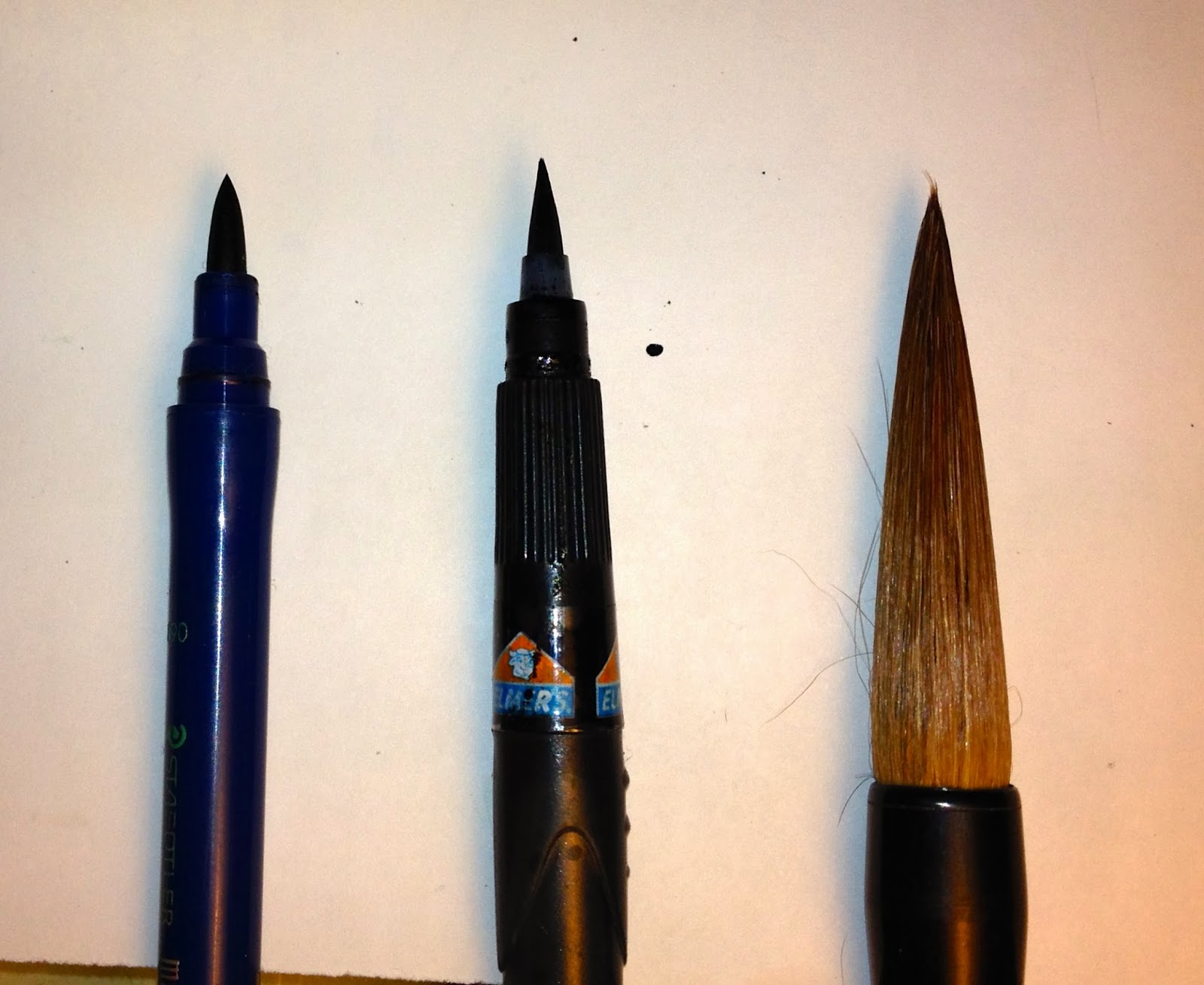
When you choose your writing brush, you can decide how authentic you want to be.  There are three main categories to choose from.  
  • Easiest to use is a brush marker (at left), which offers a somewhat flexible felt tip and its own internal supply of ink.  
  • A fountain brush (middle), like a modern fountain pen, holds a supply of ink inside its handle. *  
*Some are refillable, others are not.  Its brush fibers are synthetic and its body is plastic.  
  • The classic brush (at right) is made of fine animal hair held in a hollow bamboo handle; you dip it in a shallow dish of ink to keep it supplied with ink.  Its size can range from tiny to mop-size, and its price from a few dollars to a few hundred.  
Make a realistic assessment of your skill level, and don't be afraid to start simple and get more refined as you gain mastery.  

Tuesday, February 11, 2014

Vietnamese calligraphy: the Hybrid Best of East and West. 1.0 Materials

Lesson 1: TOOLS

To write Vietnamese, you'll need the right tools: a pointed brush, intense black ink, and soft uncoated paper.
  1. The brush should be made especially for Asian calligraphy: soft and pointed.  A reliable source: 
  2. While you could grind your own ink by hand from a stick of pigment, bottled ink in a flat dish is fine for practice. A reliable source:
  3. "Rice paper" is actually made from mulberry fibers, and is sometimes labeled Sumi.  A reliable source:
The history behind these tools is explored pp 64-67 in my book Learn World Calligraphy. 
  

Left: Brush strokes form alphabet letters.  

Sunday, February 9, 2014

Vietnamese calligraphy: the Hybrid Best of East and West. Introduction


                                          INTRODUCTION
 
The Vietnamese language is written with Roman letters, a surprise to many Westerners who imagine vaguely that it still uses some kind of Chinese script.*  Instead, Vietnamese calligraphers and type designers have created a distinctive--unique!--writing style that blends Asian brush techniques with the structure of the ABCs.  


*Vietnam broke free of Chinese rule some 1000 years ago, evolved their own set of characters for a few centuries, then welcomed the alphabet 300 years ago.  Roman letters have been the official national script for over a hundred years.  
Brush strokes, phonetic letters.  

To understand Vietnamese calligraphy we will first review traditional brush techniques.  Strokes like these are also used to write the very different characters and letters of China, Japan, and Korea. 


The antiquated Chinese-based nôm characters appear only on ceremonial occasions and holidays like New Year.  Here, a traditionally-costumed sidewalk calligrapher writes New Year's wishes for hire, and monk Minh Duc finishes a scroll.  

One expert estimates that "only 40 people remain who can read nôm characters."    


Saturday, February 9, 2013

35: Thu Phap


Thu Phap is the national style of Vietnam, where calligraphers for centuries have been forming the Roman alphabet with the strokes of the Asian brush.  This first, and best, fusion of East and West is still a national treasure, showcased during the New Year by calligraphers who line the sidewalk at special streets in Hanoi, Hue, and Ho Chi Minh City. 

I am just beginning to learn this style.  

A young woman in traditional North Vietnamese dress offers New Year greetings to order in Hanoi 
just outside the Temple of Knowledge. 

Hold the brush upright and vary the pressure.  Red is the traditional color of celebration.