Showing posts with label Translation. Show all posts

Sunday, August 27, 2017

Thoughts on translation, Part 6: What is an appiryon?

Song of Solomon: timeless love poetry in contemporary calligraphy. 

Song of Songs is a translator’s nightmare—or a paradise, if you enjoy a challenge. Nearly one word out of ten is what scholars call a hapax legemenon, a word that isn’t found anywhere else in the Bible, so there is nothing to compare it to.  You have to just wing it.  Many of these words also don’t occur in other texts from the period, leaving even the most scholarly translators to take a stab at what the poet meant.  

For example, in the lyrical passage about Solomon’s betrothal, III: 6 - 11, he sits on an appiryon, which the Orthodox Jewish Bible translates as a mobile throne carried on a litter on the shoulders of men.  But other translators preferred to call it a palace, a bed, a palanquin, a curtained couch, a chariot, a litter, a carriage, or a car of state. NetBible says “it has no Semitic cognates and is of dubious meaning.”  So, no single word in English translates this exactly.  (Furthermore, this vehicle may have been made by him or for him; Hebrew is short on articles and prepositions, not to mention vowels.)  

After a lot of reading, I decided to just create the illusion of looking upwards--to the "pillars of smoke", to Solomon raised at least to shoulder height, and to the crown "wherewith his mother crowned him."  

Wednesday, August 23, 2017

Thoughts on translation, Part 4: Many works of art benefit from translation

Song of Solomon: timeless love poetry in contemporary calligraphy.  


I'm a lieder fan, and I even know a little
German, but I still wouldn't know
exactly what is going on if I didn't
study up before and after a concert like
this one by Dietrich Fischer-Dieskau.  

Translation is not unique to words that you see.  Singers face this issue when they perform lieder, solo art songs mainly from the 19th century.  Singing in the original German words will leave average listeners mystified, no matter how eloquently the very best singers mime the ideas with face and gesture; or they can sing in English, irritating the purists in the audience but clarifying the text for their listeners.  Opera buffs can expect to view supertitles in English at American performances; but lieder audiences have to make do with printed translations they can consult before the lights go dim.

You can enjoy looking at this but unless you are fluent
in Latin you won't have much clue what it is about.*
 

People who like the purely visual experience of "reading" calligraphy in languages they don't know will miss the extra pleasure that comes from knowing what the text says.  

Words matter but ideas matter more.  Like a singer, a calligrapher's purpose is to add clarity and depth to words. 

*  This text  bridges the transition from Ecclesiastes to Song of Songs, adding some opinions from the scribe as to what it is all about.  You can see the translation here.
  

Saturday, August 19, 2017

Thoughts on translation: Part 3: Ask for guidance

Song of Solomon: timeless love poetry in contemporary calligraphy.  


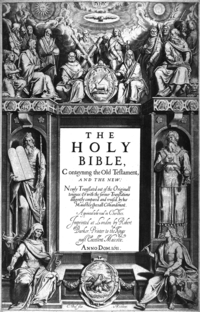
The title page's central text is:"THE HOLY BIBLE,Conteyning the Old Testament,AND THE NEW:Newly Translated out of the Original tongues: & with the former Translations diligently compared and revised, by his Majesties speciall Comandement.Appointed to be read in Churches.Imprinted at London by Robert Barker, Printer to the Kings most Excellent Majestie.ANNO DOM. 1611 ."At bottom is:"C. Boel fecit in Richmont.".
King James Bible, first authorized
English translation, 1611. 
In the Middle Ages, people who translated the Bible from Latin into English, or who simply advocated it, could be excommunicated and burned at the stake.  By the early 17th century, political and social change paved the way for the King James translation. Today, the consensus among most American clergy is that spiritual meaning is more important than grammati-cal details.  We are a nation of many religions, which co-exist by respecting each other's customs.  

Ask your minister (and your god) about modifying scripture in the service of art; my ministers confided that "We all do that,” tweaking their translation so the listener understands it better.  Think about how Handel's Messiah oratorio added profound depth to scripture, even though his librettist rewrote the words to suit the music.  Find out how much latitude your own church or temple allows, so you can be comfortable when you choose a translation, add your art, and share it.     

Wednesday, August 16, 2017

Thoughts on translation, Part 2: What IS the original language?

Song of Solomon: timeless love poetry in contemporary calligraphy.  
Scripture in Greek.  


Turning a translation--of poem, prose, or scripture--into calligraphic art gives you the opportunity to fine-tune the words in English. Despite all precautions, text is a man-made approximation, in a human language, of what God said and did.  Scripture is about the God we worship, not an object to be worshipped itself.*  The language is not as important as the thought.   

Much of the Bible has passed through half a dozen other languages on its way to English—Biblical Hebrew to Aramaic to ancient Greek to Latin… 
Scribes also modified the text with contractions, abbreviations, ligatures, and, inevitably, mistakes. Some of these got passed along to the next generation.   


Calligraphy is no longer the only way the Bible gets transmitted, so word variations are now no threat to its continuity.  The scribe is freed up from copying, to focus on creating.  When you design a work of modern letter art using ancient text, you are also entitled to choose which translation you use in the service of clarity and unity.  
_______________
* The KJV scholars declared that they "never thought from the beginning that [they] should need to make a new translation, nor yet to make of a bad one a good one, ... but to make a good one better."  They also give their opinion of previous English Bible translations, stating, “…[even] the very meanest translation of the Bible in English containeth the word of God, nay, is the word of God."