Showing posts with label pixels. Show all posts

Saturday, March 19, 2016

Embroidered Signatures on Quilts

Palmer capital F.
riendship quilts or signature quilts are a quintessentially American objects.  In the nineteenth century the signatures would have made with indelible ink; later, the names were made more permanent and decorative with embroidery thread.  The finished quilts were often used by groups of women as gifts or fund-raisers.  


Signature quilt from Cyril, Oklahoma.  
The 1937 quilt I recently inherited and sent back to its hometown was made of pieced starbursts with a signature at the center of each.  The calligraphy of the signatures itself interests me, since the women who wrote them would have learned their penmanship at around the same time, and some of them possibly from the same teacher.  The letterforms they used were characteristic of Palmer Method, a teaching program popularized from 1900 to 1950.  At one time more than 3/4 of all students in the US learned their penmanship using this system. 

Although the demands of embroidery tend to simplify the line, you can still see Palmer's characteristic, archaic, sometimes peculiar letter forms in many of these names. 
  
Capital B and capital L, and small b, follow Palmer rules.  
Capital D is a Palmer Method capital.  


The capital N follows Palmer method
rules that make the first stroke of
capital M, N, and W much taller 
than the right half of the letter.

Capital I and capital G are distinctive Palmer Method
forms, as well as the small r. The capitals are supposed 
to be three times the height of the small letters.  


2
Quilts that incorporate letters are endlessly fascinating.  I hope to hear from other fans of this American art form.  

Saturday, March 12, 2016

Women turn quilts into documents


The signature quilt I mentioned recently has written its own second chapter.  After a good 70 years in our family's attic, it seemed ready to go back to those who made it.  I've learned from my mother and my sister that when you inherit a handmade artifact that seems to tell a story--research it. So I got in touch with the local historical society in the town of Cyril, Oklahoma, and found what so many American towns have--people who cherish their own history.  
Many citizens of this town of 1100 people are children and grandchildren of the women [and one man] who signed and embroidered their names on this quilt some 80 years ago, and now that I have got organized to send the quilt to the Historical Society, they too can enjoy how it opens a window on the past.  Their comments can be seen on the CHS Facebook page for March 7.

Cyril Oklahoma and its historic quilt on Facebook 

The next time you itch to clean out your attic, don't just give stuff away; find the right home for it.  Especially if it has writing on it.  Stop and think about how and where a simple object can connect people to each other, and to their own past.  All it takes is a little sleuthing.  
We will look at those signatures up close in the next post.  Signature quilts are a special American tradition.  


Tuesday, March 8, 2016

Women turn scraps into masterpieces

A detail from a pieced and embroidered quilt, one of dozens that my husband's parents accepted in lieu of payment for goods from their general store in Cyril, Oklahoma, during the 1930s.  The center of each star has an embroidered signature, most likely of the group of women who helped with the final quilting and assembling.The initials O E S probably designate a member of Order of the Eastern Star, a women's group.  
Today is International Women's Day, a good time to celebrate the virtuoso work done by women fiber artists. Chief among these treasures are the thousands of wholly original designs for pieced quilts.  Women worked alone at home, but they also often collaborated with their neighbors. Stitching the finished quilt top to its filling and backing was almost always a group project, which provided companionship and helped spread ideas about design and fabrication.  
Yesterday, my post featured some letters made up of scraps of fabric. But that's not the only way letters were stitched into cloth.  Embroidered signatures were a favorite addition.  The quilt above is a rich cultural document that has an important story to tell about the town, the women, the material culture, the era, and the national values that shaped it.  
Whatever else women create, they create connections.  

Monday, March 7, 2016

Quilts piece by piece

"UILT" is a general term for a multi-layered blanket held together with stitching; it has come to designate the kind with a top layer made of sewn-together pieces.  This folk craft has evolved into an art form that makes images, patterns, and words out of small bits of cloth.  
American quilts celebrate the resourcefulness of frontier women coping with isolation and making do with very scarce resources. Innovating on their own, they created new traditions in their patterns and designs.  Especially after 1800, when fabric dyes became more permanent, they invested many hours in transforming the scraps of material left over from family dressmaking into beautiful blankets and covers.  Men's shirts, less tailored to the body, could be cut from white cotton without wasting material, but even when pattern pieces for women's fitted dresses were tightly spaced, they left patches of unused fabric.  These strips, squares, and irregular triangles or hexagons became the raw ingredients of a pieced quilt.  American quilters created an infinite variety of patterns: "Log Cabin" from strips; nine-piece and all-over grids of squares; starbursts from long pointed scraps: and virtuoso renderings from triangles and hexagons.  

The attitude of the local community was a key element in elevating this folk craft into art; people valued thrift, industriousness, and making do on very little. Women who worked with their hands were admired, not stigmatized, and a life of leisure was not an American goal. Innovation was welcomed and shared, not feared.          

Early in the 20th century the craft and art of quilting became popular in England, where, separated from its roots in pioneer thrift, it nevertheless appealed to women for its artistic expressiveness. By 1930 the craft was so highly developed that American women could trade their quilts for merchandise, collaborate on them for local occasions, and exhibit them to spread designs and ideas. By 1950 American curators and collectors had begun to seek out and preserve quilts, both for their designs and for their cultural insight.   


These were part of a 2011 show of some 600 vintage red and white quilts, an American favorite.

Quilters fill all kinds of grids with all shapes of pieces. Hexagons or triangles [above] demand extra skill to prevent stress on the seams where a bias edge may join a straight edge. And, letters on a hexagon grid are a harder design task than on a square grid [right].  


Alphabet quilts could follow the same 
grid as needlepoint letters.  
  

Incidentally, quilts were pieced from new scraps, not old rags.  Too much work went into them to risk having them wear out right away.  All the pieces in a quilt must be new, and of similar weight, to avoid weak spots that would pull apart in the wash or during use. Rags were used in braided rugs. 


Friday, March 4, 2016

Threads of meaning

In America, calligraphy made of individual dots has its own distinctive history; one important sub-category is letters made of stitches.  Stitched letters can be seen in embroidery, needlepoint, knits, pieced quilts, or woven fabrics. They call for many of the same artistic choices about grid, resolution, and contrast that mosaics and human banners require [see previous posts Feb 28 and March 1].  But they also offer choices that are more fun and add up to richer visual texture.  
Letters made of thread are not limited to a simple square grid and a round dot.  ●●●●   =   😴  There are lots of other choices: 

One.  Fiber artists can choose from a wide array of non-square shapes on non-square grids: 

  • triangle  ▼►▲◀︎ quilts, 
  • hexagon   ⬢ ⬣ quilts,
  • chevron v ^ / \ knit, duplicate stitch  

Two.  Even on a square grid, thread can express a number of visually interesting non-square shapes.  


  • cross stitch x  
  • woven +  
  • bargello I  
  • needlepoint


So when you make letters using stitches, you can explore a visual texture that few other kinds of calligraphy offer.  I like the way that stitches look like letters and wingdings. After all, text, texture, technique, context, and textile come from the same root word for making things.    

Wednesday, March 2, 2016

We Hereby Resolve

Resolution is another crucial choice the calligrapher makes when assembling letters out of separate bits.  The fewer and larger they are, the faster the work will go; the more numerous and smaller they are, the smoother the contours of the letter will look.  
Letters can be made by dots at greater and greater resolution.  

We read grids every day, from needlepoint to digital fonts to football fans.  The human eye will do its best to read any collection of bits as letter: even a 5 x 5 grid can express  every letter of the alphabet without ambiguity; with a little awkwardness the numerals can be included; there is even leeway for a little decoration.  
The lightbulbs on the old Goodyear blimp are
easier to read from far away than up close.

Scale is also to be understood in relation to actual size: a small, low res letter is actually easier to read than the same letter blown up big.   


Monday, February 29, 2016

All Together Now

Your eye and brain are programmed to look for meaning everywhere, so even a very few items can carry a message.  The first road sign made by the first human may have been a cairn like this, a pile of stones that says "Here is the path."  
The bits that make the message can be anything: pebbles, stitches, chopsticks, corn cobs, people, pixels.  We can call them mosaics, rasters, grids, arrays. They add up to beautiful, inventive letters that have a special place in American lettering.  They spring from the attitude that declares, "Let's get a committee together and everyone can contribute."  Letters that are made by a group have a special place in American life; crowdsourcing is in our DNA.  
    
When you arrange small items into larger images, you get to enjoy making lots of artistic choices about color, scale, and texture.  One of the most important decisions is whether to allow the contours of the individual bits to determine how they are arranged, or to force them to conform to a regular grid. 

These mosaic letters are irregular, or "crazy quilt." 
Here are two contrasting approaches, drawn from distinctly American letters: 
These quilt letters are like pixels on a square grid.
And here is a third, hybrid approach.  
The white tiles of this New York
subway sign 
follow the strokes
 of the letters, but most of the back-
ground tiles conform to a square grid. 
  
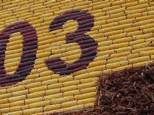
This mosaic is from the
annually-decorated Corn
Palace in Mitchell, SD. A
true American artifact.
The grid  of corn cobs is
rectilinear but also
sightly irregular.  
I hope you'll start looking at the many kinds of dots that form the letters you read, both onscreen and in the real world.  Ask yourself: What makes them calligraphy?  What makes them American?  


Thursday, January 21, 2016

What makes it American? What makes it Calligraphy?

I’m mainly interested now in American calligraphy, the topic for my future book The ABCs of the USA.  Most of the established calligraphers that I talk to say there isn’t any such thing, that "real calligraphy" can only come from the Roman, Medieval, and Renaissance styles of Europe.  So I think I may be on to something; when people can’t see an idea that is clear to me, it’s time to write a book. 
Every other American field has had to establish its independence from the Old World--philosophy, architecture, music, dance, fashion, and even spelling.  It's time calligraphy got recognized too.     

I’ll be posting examples of the letters that I see around me, here in Boston and from my travels in the USA.  What could be more American than those? 

What makes it American?  What makes it calligraphy?  Your comments are always welcome.     


Here’s a detail from a unique American gem. The Corn Palace in Mitchell, South Dakota, is covered annually with elaborate, eye-catching mosaic pictures and letters.  They are made out of—what else?!—corn cobs of yellow, red, purple, and black.  Americans have a long history of improvising letters out of individual dots, including such techniques as beading by Indians, lightbulbs displays on the Goodyear Blimp, and football fans in the card section.  All this creativity led to the first pixellated letters, and dominance in the field of digital typographic design.