Showing posts with label Gothic. Show all posts

Wednesday, June 22, 2016

A modern Finnish Gothic alphabet

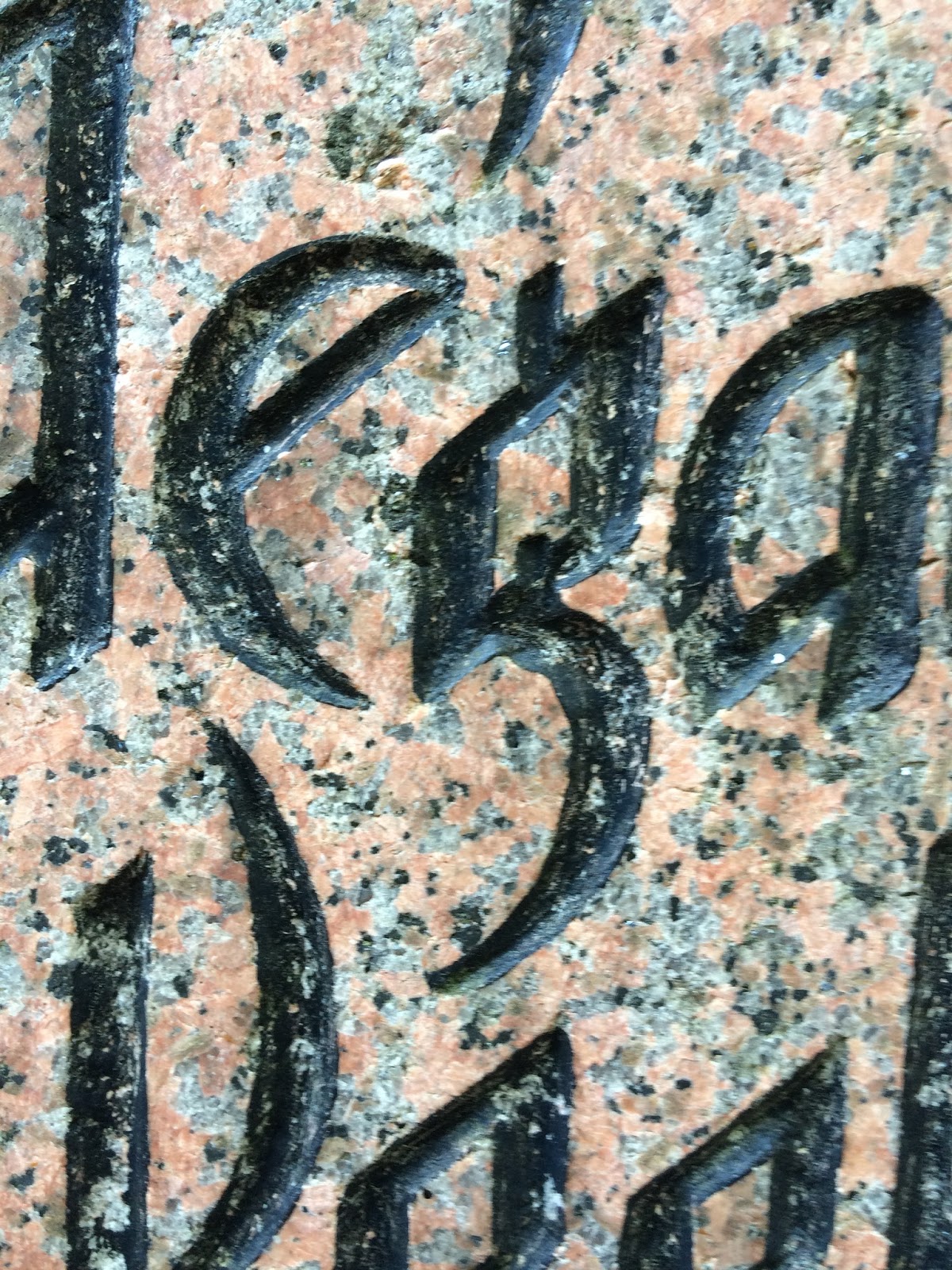
Last week, I noticed this war monument* in the Kamppi cemetery, by the Old Church in Helsinki.  It is carved in a stark, forceful version of Gothic, without the square serifs but with the same heavy width of stroke and uniform letter bodies.  Letters have to be robust to survive being carved into granite, a process undertaken today almost invariably with a power chisel.  


The letters e and a break up the rows of vertical
strokes, with half- or whole-round shapes, 
The letter g shows the kind of calligraphic
ingenuity that brings a smile to a calligrapher's
face. And the thought: I've got to try that one!  


The same message appears in three languages: Finnish, Estonian, and Swedish.  


* "The...monument in the Old Church Park was erected in 1919 in memory of the Finnish volunteers who fell in the Estonian war of independence. The bodies of 25 Finns from Helsinki were carried back from Tallinn aboard the icebreaker Wäinämöinen, and a service was held on 16 February 1919." From Park Walks in Helsinki website. 

Sunday, December 15, 2013

Christmas cards, conventional or innovative

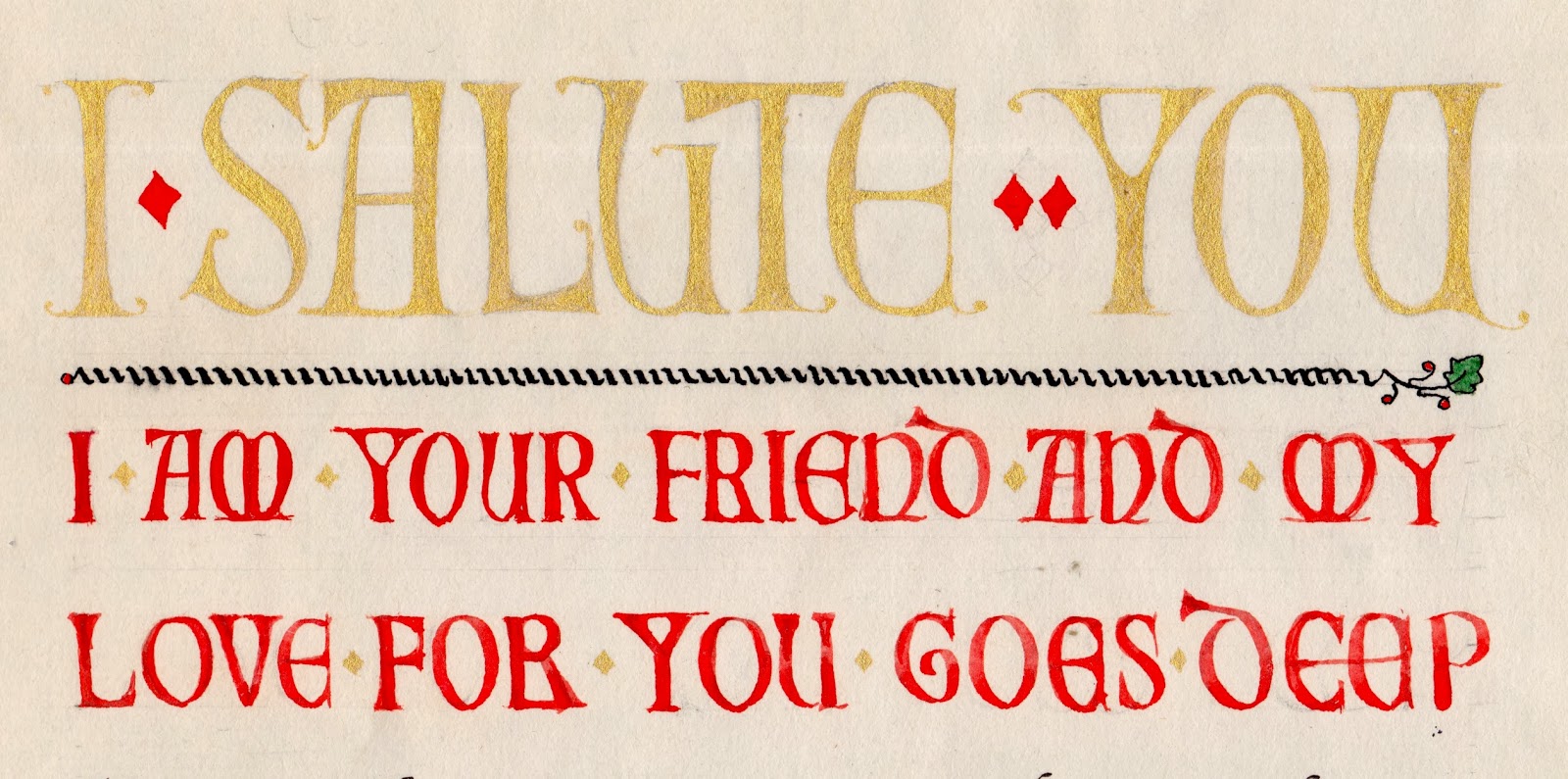
Gothic letters are inspiring to design with.  Their medieval flavor is closely identified with Christmas customs, which mainly came from Germany via 19th century England.  But also, their abstract hexagonal shape helps them express creative contemporary calligraphic layouts.  

The greetings above offer two different approaches: a conventional illuminated page with large capital and leafy border, or letters in white falling out of a midnight sky. You can experiment along the whole spectrum from the familiar to the unexpected.  

Saturday, December 14, 2013

294 Snowflakes

I love what happens when letters repeat.  In Snowflakes, I have oriented each letter, done in pointy Gothic outline, at a 60° angle around a center point.  Voila! a calligraphic blizzard.  


Thursday, December 12, 2013

292 Elf dot

Note: I got a little rushed on this alphabet: I forgot to use waterproof black ink for the outlined title.  Red and green watercolor inks made it run.  If you take care, you don't have to make that mistake. 


This is simple: take yesterday's Elf and add a gold dot where red meets green.  


Wednesday, December 11, 2013

291 Elf


Elf is just a simple nod to "It's Christmas!" Use basic outlined Gothic letters and fill the upper half with green, using a brush or pen.  Let it dry completely.  Wash out your brush or pen.  Then fill in the lower half of the letters with green.  

You could add a gold dot to where the colors meet.  Let's make that modification tomorrow: 


Friday, December 6, 2013

287 D Nib Gothic


This heavy, emphatic alphabet is made by writing basic Gothic with a Speedball D nib pen.  Its difference from a sharply broad-edged nib isn't obvious at first, but it grows on you.  

Thursday, December 5, 2013

Churchy

I don't really have a whole alphabet today, but want to share a raised inscription I s on 57th Street during a recent trip to New York. 
Maybe you can derive the missing letters from those here.  


Details below and left.  The Y is unusual. 

Wednesday, December 4, 2013

286 Back slant Gothic

Back Slant Gothic is an extra-tall version of "Disinclined Gothic" we saw earlier (August 10 # 188).  

Friday, November 8, 2013

265 Complex Medieval caps + dot


I used a Speedball B to make the dots all the same size.  You can just make circles with a small pen and fill them in.  
In addition to yesterday's Complex Medieval caps, you can add a decorative disk to the very thin curves.  I've shown this on most letters except A V W X Y Z; you may want fewer of them.  Or more!  


Thursday, November 7, 2013

264 Complex Medieval capitals


Complex Medieval builds on yesterday's Simplified Medieval.  Transform the letters with a mix of these six steps:
  1. Choose forms of E H M N T W that are less modern and more medieval.
  2. Exaggerate the contrast between thick and thin parts of curves.
  3. Make the outer curve a little sharper.
  4. Lower the corners of B D F P R...
  5. And extend their serifs, as well as those of P and H.
  6. Add a dramatic bulge and taper to one stroke in A H J K M N Q R T X Y Z
  7. An alternate M can be derived by rotating the W 180°.

This quotation starts with large caps carefully rendered in powdered gold paint, known as "shell gold."  The smaller red caps are heavier, more like yesterday's  Simplified Medieval. It ends with the attribution, to Fra Giovanni also in shell gold. 

I haven't shown the text lettering itself.  This was only the third piece of calligraphy I tried, back when I was a beginner.  Actually, I'm still a beginner...  


Preview of tomorrow's alphabet.

Wednesday, November 6, 2013

263 Simplified Medieval caps

These drawn and filled in letters are not as refined as I would would make them for a formal design.  I just drew them to illustrate the two-step process.
When medieval scribes wanted to start their text with an enlarged word or two, they often chose to draw Roman letters, which came to be called Versals or Lombardic capitals.  I've named these Simplified Medieval caps, because they render the classic forms in a style that highlights their decorative inner spaces and hairline serifs.


Outline, to be covered up.  
Here is the first, outlined version; a scribe or illuminator would have sketched the letter in diluted gray or brown ink, intending to cover the outline with the final solid color of red or blue paint, or gold leaf.  The outlines--shown in black here--are not meant to be seen by the final reader; they just suggest where to paint or gild.


Tuesday, November 5, 2013

262 Original Medieval caps

I've left the J and V and W blank for your own versions.  

I recently traced these Original Medieval letters from a page that provided models for an illuminator to dramatize a paragraph once a scribe had lettered the text.  These letters are much more individual than modern versions, which tend to try to look like a font with uniform letter bodies and line endings.  Sometimes tracing is the only thing that will keep you from needlessly improving and updating an alphabet--not necessarily a bad thing but it's hard to stop doing.  
Source of initials.  


Tracing calligraphy is like historical re-enactment; you learn to do what the person of the period did, without trying to impose your own interpretation onto it. 


Thursday, October 31, 2013

257 Skeletal Gothic

Ever since the Gothic Revival of the 19th century, its calligraphy has been connected to things wild, romantic, mysterious, eerie, and otherworldly.  Here is Skeletal Gothic, a blank slate for you to enjoy filling with ugly colors, unpleasant textures, or Halloween motifs.  The extra letters O at the bottom are for you to experiment with.

Wednesday, October 23, 2013

251 Lowlight


Lowlight is so easy, and it creates such an odd illusion.  If you fill in the top, not the bottom, of any outlined letter with dark ink, it looks like the light is coming from below.


Monday, October 21, 2013

249 One with everything


Each letter has two colors, a gold dot, and a drop shadow.   

This one takes some explaining. 


A typical Book of Remembrance, from Canada. 
One of my first freelance clients was a company that supplied merchandise for churches--palms for Palm Sunday, bulletin forms for weekly services, choir robes, etc.  My task was adding names to "Books of Remembrance," big, ornate, leather-bound volumes that many churches maintained and displayed to honor their donors and supporters.  I had to continue their lists using the style of the original scribe, which meant that I ended up learning to imitate alphabets from as far back as 1910.  It was like doing archaeology and a historical re-enactment together.  


This was one of the most popular styles I encountered, which I call One with Everything.  I would NEVER suggest that you use this except as a heavy-handed way to suggest a bygone era, but you can load everything onto the alphabet just for fun.  And it makes your other freelance jobs seem easy.   


Thursday, September 12, 2013

216 Gothic plus


This alphabet, Gothic Plus, adds a variety of decorative strokes to the bare bones of  basic Gothic: double stroke, small stroke, banner, staff, hairline, square dot.  


A common use of Gothic caps, here with a few extra strokes (B) and vertical hairlines (T G).  


Simple, decorated, or elaborate
You can adapt your own versions of the examples above, or push even further with more parallel strokes, interweaving, filigree as shown here at right.  


Wednesday, September 11, 2013

215 Redoubled Gothic caps

Y needs one more decorative stroke.  

Redoubled Gothic adds a little more ornament compared with yesterday's Doubled Gothic (left); two little strokes overlap the left stroke of half of the letters (except U and Y with the strokes inside, Z and W with the internal dash, and A C E G O Q S T V X with no extra strokes).

  
There are in fact at least three kinds of small strokes that can be added: square, parallelogram, curve.  And three are three ways to add them: float (not shown), touch, overlap.  The diagram at right comes from the Gothic capitals chapter in Learn Calligraphy


Tuesday, September 10, 2013

214 Doubled Gothic caps

These come from the dozens of alphabets offered in my book Capitals for Calligraphy.  

These caps, Doubled Gothic, are built on yesterday's Bare Bones Gothic(left). Each letter holds a doubled stroke, tied together with two hairlines.  

You can of course try out your own designs for the basic letter structure.   I lettered this alphabet a couple of decades ago and I've written a LOT of Gothic capitals since; in retrospect, the doubled lines look a little close together.)  
  

Monday, September 9, 2013

213 Bare Bones Gothic


This Gothic alphabet is stripped to its essentials.  The outlined strokes are optional.  The dotted strokes help fill the space. 

Bare Bones Gothic reminds us that although Gothic capitals have a reputation for fussy ornateness, they are actually built on a simple framework.  Almost every letter is built on three strokes or fewer.
From Learn Calligraphy. 

Then you can decide how much to decorate them. Ornament can be sorted into five basic categories of extra stroke: 

  1. Banner
  2. Hairline, often the stem of the banner
  3. Doubled (and tied)
  4. Square that touches the stem of the banner
  5. Square that floats

Traditional scribes used simpler capitals within the text and more ornate capitals when time and space allowed.  

Simple letters deliver the most Gothic flavor for the fewest strokes, and provide a starting point for the increasingly ornate alphabets that follow later this week.  
Preview of tomorrow's alphabet.
  

Friday, September 6, 2013

211 Heraldry Language

This alphabet, Heraldry Language, derives from Heraldry (July 9, #160).  It shows how the colors, patterns, and precious metals of medieval heraldry can be specified with great precision using words from a special vocabulary.  After reading the description, the illuminator used his own imagination and talent to create the escutcheon.*  
* If that word brings you to a screeching halt, think how I felt when I first encountered it on the SAT in high school.  Not fair!  I've made a point of using it here so you can ace your own tests.
There are a lot more ways to fine-tune the description of a family crest.  But these will get you started.